
Edge AI vs. Cloud AI: When to Use What—and Why You Don’t Have to Choose
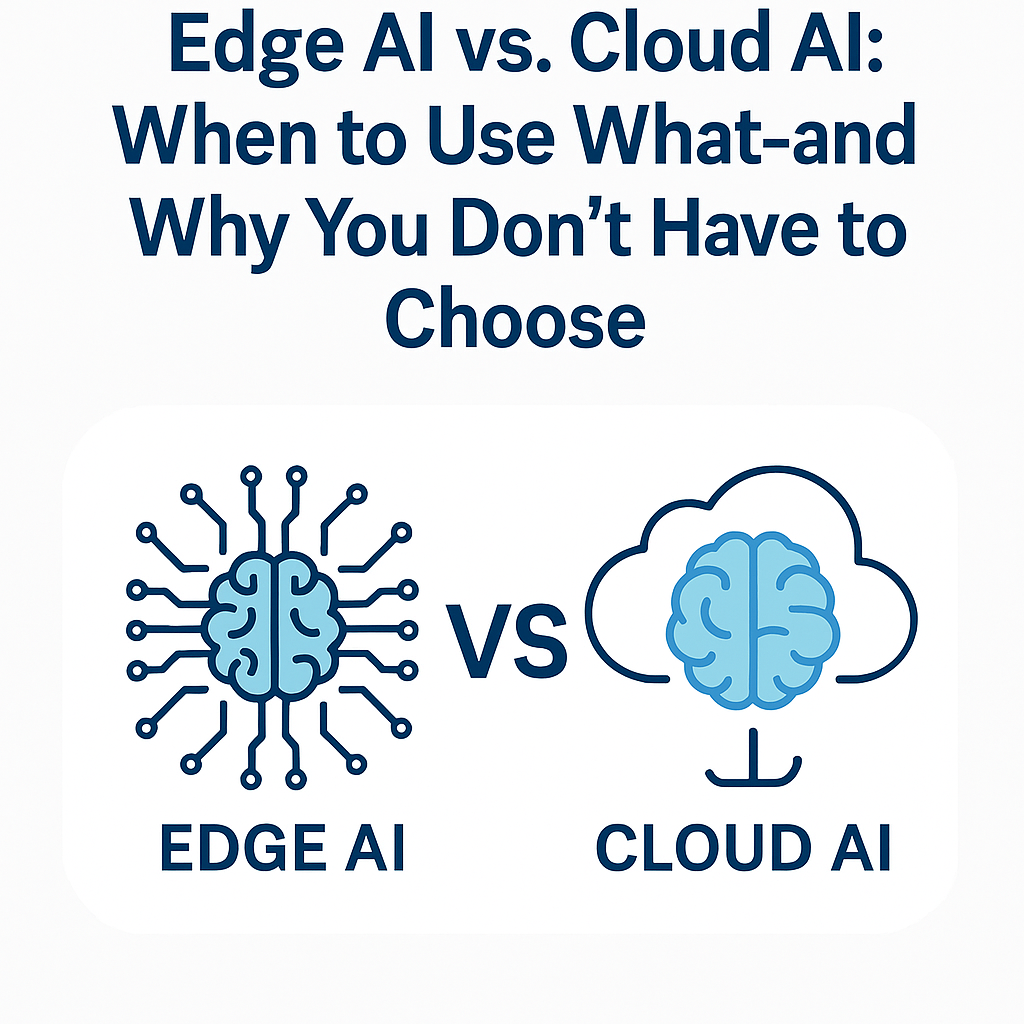
AI is in your roadmap. The only question is how far from your data it should live. Some
teams default to cloud because it’s scalable; others swing toward edge for speed and
control. But what matters most isn’t where the AI lives, it’s when each placement earns its
keep. Edge AI and Cloud AI aren’t rivals. They’re situational tools, and your operations
depend on knowing which one to reach for, and why.
Edge vs. Cloud Core Concepts
Edge AI runs directly on devices—hardware in the field that processes data where it’s
generated. That might mean a factory robot analyzing vibration patterns or a security
camera detecting motion without sending footage to the cloud. In contrast, Cloud AI sends
data out to centralized servers for processing, drawing on immense compute resources and
shared models. These architectures aren’t interchangeable, they’re built on different
assumptions about latency, bandwidth, and scale. Edge is tight, local, reactive. Cloud is
expansive, centralized, and built for deploying deploying models on the device only after they’ve been
trained somewhere bigger.
Real-Time Demands Change the Equation
When a machine needs to make a decision faster than a human can blink, Cloud AI can’t
keep up. That round trip—device to server, server to response—creates delay that’s fine
for analytics, but fatal in the field. Think robots dodging forklifts or vehicles avoiding
collisions. These aren’t compute problems; they’re timing problems. Edge systems,
designed to react in milliseconds, eliminate network round-trip delays and give machines
the reflexes they need. If latency kills, Edge AI survives—and thrives.
Privacy Isn’t Just Policy—It’s Architecture
Data doesn’t always want to travel. In industries under the thumb of GDPR or HIPAA,
sending raw user or operational data to a remote server isn’t just risky—it’s often illegal.
That’s where Edge AI offers more than performance—it offers protection. By running
models where the data lives, teams can process sensitive events without leaving the
premises. That local loop means you can process data in-line with GDPR while keeping
compliance officers and security teams out of cold sweats. In highly regulated
environments, Edge becomes the path of least resistance.
The Cloud Lifts What the Edge Can’t
When the task is training a massive model on a mountain of historical data, the edge simply
can’t cut it. It wasn’t built to. That’s where the cloud’s elastic horsepower
shines—especially for resource-intensive, multi-phase model development. You can spin
up resources on demand, run experiments, and refine outputs without waiting on-site
hardware to catch up. Teams can use the cloud for heavy training, then push only the
relevant inference logic back to the edge. The two systems play tag, not tug-of-war.
When the Signal Dies, the Edge Keeps Thinking
Let’s talk outages—not if, but when. Rural networks, storm interference, or dense factory
zones can break the cloud’s chain. If your system dies with the signal, that’s not AI—it’s a
liability. Edge systems are built for this. They maintain function offline, analyzing inputs
and responding autonomously even when upstream access disappears. That’s what makes
them so valuable in critical, low-connectivity environments.
They Don’t Compete. They Complement.
Smart teams stopped picking sides a long time ago. Today’s best architectures orchestrate
edge and cloud workloads seamlessly. Let the edge handle real-time response while the
cloud crunches aggregate insights. Infer here, learn there, sync everywhere. It’s not a trade-
off—it’s a choreography. Hybrid design isn’t theoretical—it’s survival strategy.
What You Run It On Matters
All this edge capability means nothing if the hardware can’t handle the heat. Industrial
environments don’t care how optimized your model is if the machine shuts down after a
vibration spike or dust storm. That’s where a rugged panel computer becomes more than a
spec sheet—it’s the anchor. These systems support real-time processing in harsh
conditions with fanless durability and flexible connectivity. Add high-brightness
touchscreens and glove-friendly inputs, and you’ve got edge intelligence that doesn’t blink.
Reliability starts at the silicon and works its way out.
Edge AI moves with the moment. Cloud AI learns from the long view. Your job isn’t to
choose between them. It’s to know which to trust when the stakes change—and build a
system that does both without blinking. Treat them not as rivals, but roles. That’s where
the advantage lives.
Explore the full potential of AI for your organization with ai4org and transform your
operations with cutting-edge solutions tailored to your industry needs!
Written by: Dean Burgess